The brief was not a redesign. It was a clean exit.
Replaced PowerLiens' MapQuest dependency with map infrastructure, provider routing, and a search tool PowerLiens owns outright.
Delivery
Shipped across four weeks
Commercial model
Fixed bid
Governance
Built for PowerLiens. PowerLiens owns the system, its data, and its roadmap.
Outcome
Vendor risk was removed and provider search became a maintainable production surface PowerLiens owns outright.
Replaced a paid dependency. Owned by the client.
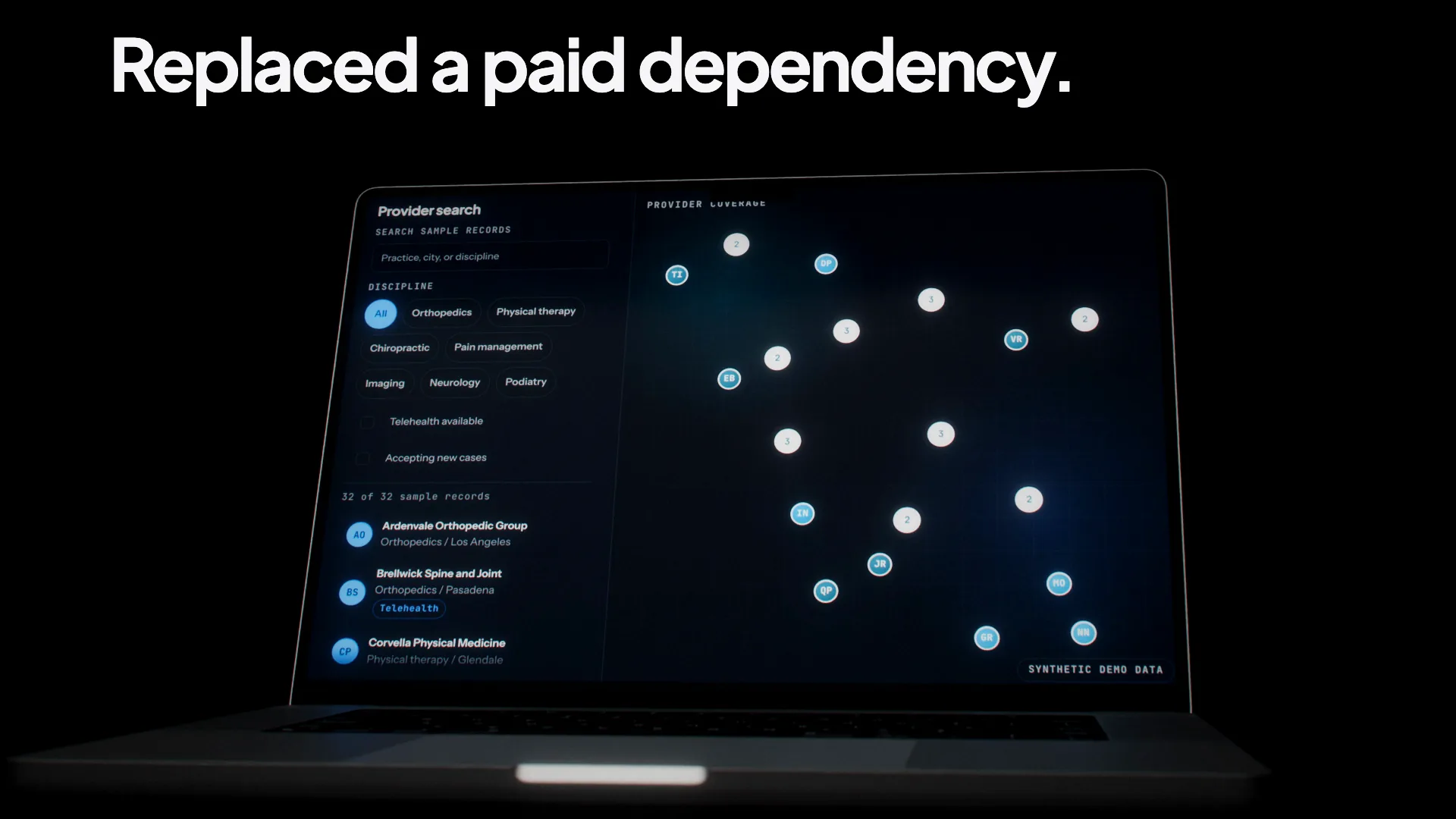
The provider search PowerLiens owns now, shown on invented demo data. The MapQuest dependency it replaced is gone.
Interface demo
The product is behind a login, so here is the pattern instead.
PowerLiens owns the production app and its records, and it is not public. This is a working recreation of the search interface, running on data ThynkQ invented for it. Search it, filter it, click a result.
Provider search
32 of 32 sample records
Loading provider field
Interface demo. Every practice, address, phone, and coordinate is invented. PowerLiens owns the real product.
A live migration, with a maintained path at the end.
Provider discovery depended on MapQuest licensing, rate limits, and an external data layer.
Migrated the mapping experience to React Leaflet with provider routing, geocoding, and a maintainable push architecture, all owned by PowerLiens.
The rollout used a controlled traffic split: PL Maps and the legacy map ran side by side, then the fallback disappeared once the PowerLiens-owned path was proven.
Before
MapQuest API carried all traffic
No control of the data layer
No push capability
During rollout
PL Maps via React Leaflet on a controlled traffic split
Legacy map kept as the fallback
Vercel Blob provider feed live
After
PL Maps handled all traffic
Geocoding and search owned by PowerLiens
Push architecture in place
Delivery
Four weeks. Four irreversible decisions.
Week 1
Foundation
React Leaflet 5 migration
CartoDB tile integration
Provider search and clustering
Week 2
Push architecture
Vercel Blob provider feed
Controlled traffic split
Legacy map kept as the fallback
Week 3
Quality pass
Map behavior and pins
Mobile QA at 375px
Performance optimization
Week 4
Compliance and handoff
CCPA consent system
Final QA
Client handoff
ThynkQ roles
Founder-led accountability, with specialist support close by.
The engagement remained founder-led. The wider ThynkQ team supports focused work across these disciplines.
Rodolf BoctorFounder, engineering lead
Ivan MihailovTechnical Project Manager
Ryan G.Product strategy & operations
Marvin HellmanAdvisor, capital and strategy
Next project
A fragile dependency is a product decision.
Start with a focused Launch Build conversation. The first step is a clear scope, not a generic sales call.